How to Choose a Lingerie Manufacturer in China: A Buyer's Checklist
- Share
- Issue Time
- Oct 30,2026
Summary
A practical checklist for vetting a Chinese lingerie factory: how to tell a real manufacturer from a trading company, the seven checks to run before you send a tech pack, and realistic MOQ, sampling and lead time numbers.
Choosing a lingerie manufacturer in China comes down to three verifiable facts: do they own the sewing lines, can they show you a bulk order they shipped in the last six months, and will they put the fabric specification and the AQL level in writing before you pay a deposit. Everything else — the showroom, the website, the price list — is easier to fake than those three.
This guide covers how to check each one, what MOQ and lead times realistically look like in 2026, and the red flags that end most first orders before production even starts.
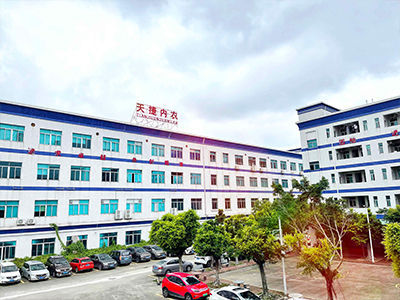
It is written from the factory side. Tianjie Lingerie has been producing bras, sets, pajamas and swimwear in Dongguan since 1998, so we know which questions buyers ask that actually reveal something — and which ones every supplier has learned to answer smoothly.
Factory or trading company? How to tell in one call
Roughly half of the companies presenting themselves as lingerie manufacturers in China are trading companies. That is not automatically bad — a good trading company can manage a supply chain you cannot manage yourself — but you should know which one you are talking to, because the price, the MOQ flexibility and the quality control all differ.
- Ask for the address and check it on a map. A factory address resolves to an industrial park or a workshop building. A trading office usually resolves to a commercial tower or a residential block.
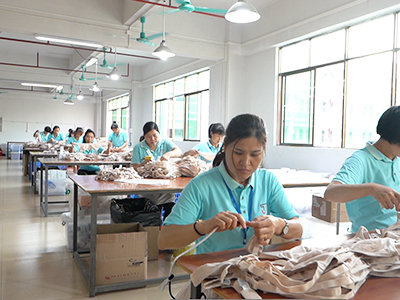
- Ask how many sewing lines they run and what the daily output per line is. A real manufacturer answers in units per line per day. A trading company tends to answer in monthly capacity, which is a number with nothing behind it.
- Ask which processes are in-house. Cutting, sewing, bonding, moulding, QC and packing should all be inside the same compound. If bonding is subcontracted, the peel strength is out of their control.
- Ask for a live video call during working hours. Not a recorded factory tour. Machines running, operators at the lines, the QC bench with someone actually measuring.
- Check the business licence scope. Chinese business licences list permitted activities, and “production of garments” appears there only if they actually produce.

Seven checks before you send a tech pack
A tech pack is your design, your measurements and your construction details. Once it leaves your hands, it is very hard to argue about what was agreed. Run these checks first.
- Fabric specification in writing. Composition, weight in gsm, stretch percentage and the mill it comes from. “Good quality lace” is not a specification; “89% polyamide / 11% elastane, 165 gsm, from mill X” is.
- AQL level and inspection point. Most lingerie factories run AQL 2.5 for major defects. Ask whether inspection happens before packing, and who pays for a third-party inspection if you want one.
- Sampling price and whether it is credited. Sample fees are normal. Ask if the fee is deducted from the bulk order — many factories will do this once you place it.
- Size grading method. Ask whether they grade from a base pattern or use separate blocks for plus sizes. Scaling a 34B pattern to a 42DD produces a bad fit, and it is the single most common quality complaint in this category.
- Trim and hardware sourcing. Who supplies the rings, sliders, hooks and boning, and can you nominate your own supplier? Nominated trims are usually fine, but it changes the lead time.
- Who owns the pattern after the order. Get it in writing that the pattern and the tech pack are yours and will not be used for another buyer.
- Payment terms and the deposit percentage. Standard in this industry is 30% deposit and 70% before shipment. Anything requiring full payment upfront is a warning.
The most expensive mistake in this category
Buyers often approve a sample, then discover the bulk fabric is a different lot with a slightly different hand feel. Ask for the bulk fabric swatch to be approved separately, and keep the approved swatch on file with both parties.
What MOQ, sampling and lead time actually look like
Numbers below are what a mid-to-large lingerie factory in Dongguan typically quotes in 2026. Anything dramatically below the low end usually means the order is being aggregated from several small workshops rather than produced in one place.
| Item | Typical range | What moves it |
|---|---|---|
| MOQ per style per colour | 1,000 – 3,000 pcs | Fabric minimums at the mill; whether the lace is stock or custom-developed |
| Sampling time | 2 – 3 weeks | Whether the pattern exists; custom lace or print adds a week or more |
| Bulk lead time | 60 – 90 days | Peak season (Aug–Nov), fabric in-stock status, number of colourways |
| Sample fee | Quoted per style | Usually credited against the bulk order once it is placed |
| Payment terms | 30% deposit / 70% before shipment | Long-term customers sometimes negotiate 30/70 against documents |
A 60-day lead time is achievable when the fabric is in stock and the style is straightforward. A 90-day quote is more honest for a first order with custom lace, three colourways and a peak-season slot. If someone promises 30 days on a first order with custom fabric, ask which mill is holding the greige goods.
Which certifications actually matter
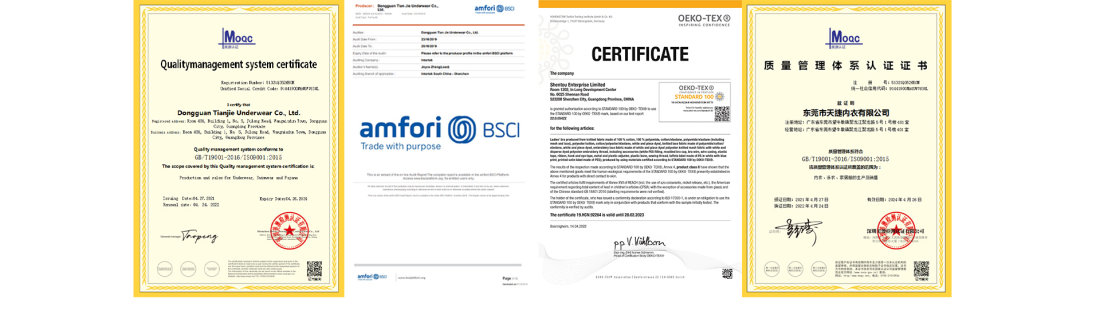
Certificates are the easiest thing to fake on a website and the easiest thing to verify. Ask for the certificate number and the issuing body, then check it on the issuer's own database — not on a PDF the supplier sent you.
- BSCI or SMETA (sedex) audit — social compliance. Your buyer's compliance team will ask for this. Check the audit grade and the expiry date; an expired report is common.
- OEKO-TEX Standard 100 — the finished fabric is tested for harmful substances. This is product safety, and it is the one European buyers ask about most.
- ISO 9001 — quality management system. Useful as a signal that documented QC exists, less useful as a guarantee of any specific product.
- GRS (Global Recycled Standard) — required if you are claiming recycled content. Note that GRS covers the whole chain, so the mill must also be certified, not just the garment factory.
- ISO 14001 / ISO 45001 — environmental and occupational health systems. Relevant for larger retail accounts, rarely a blocker for smaller ones.
Red flags that end most first orders
- A price that is 30% below every other quote, with no explanation of which component was changed.
- Reluctance to name the fabric mill, or to send a physical swatch before the sample is made.
- No live video call, only a photo gallery — galleries are frequently borrowed from other factories.
- A sample that arrives with different lace than the one in the photos you approved.
- Pressure to pay a deposit before the tech pack has been reviewed and commented on in writing.
- No answer when you ask who owns the pattern.
What to do next
If you have a style in mind, the fastest way to test a supplier is to send a reference sample or a tech pack and ask two questions: what is the MOQ for this exact style, and when can you show me a sample. The quality of those two answers tells you more than any catalogue.
Send your tech pack or reference sample
We reply with a price range, a sampling date and the MOQ for that specific style, usually within one working day.