Lingerie MOQ Explained: What 1,000 Pieces Really Means
- Share
- Issue Time
- Oct 30,2026
Summary
Why lingerie MOQs sit between 1,000 and 3,000 pieces per style per colour, which parts of the order drive the number, and the four legitimate ways buyers get it down without paying a higher unit price.
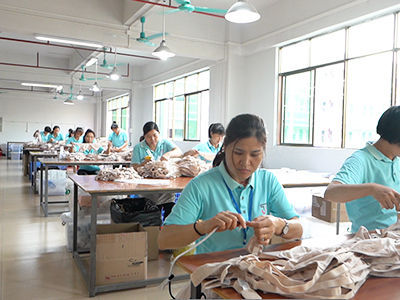
A lingerie MOQ of 1,000 to 3,000 pieces per style per colour is not a sales tactic. It is the point at which the fabric mill will produce your fabric, the dye lot stays consistent, and the cutting and sewing setup cost stops dominating the unit price.
Below roughly 1,000 pieces, the factory is either absorbing a loss on setup, charging you a small-order surcharge, or quietly pooling your order with someone else's fabric — which is where colour matching problems come from.
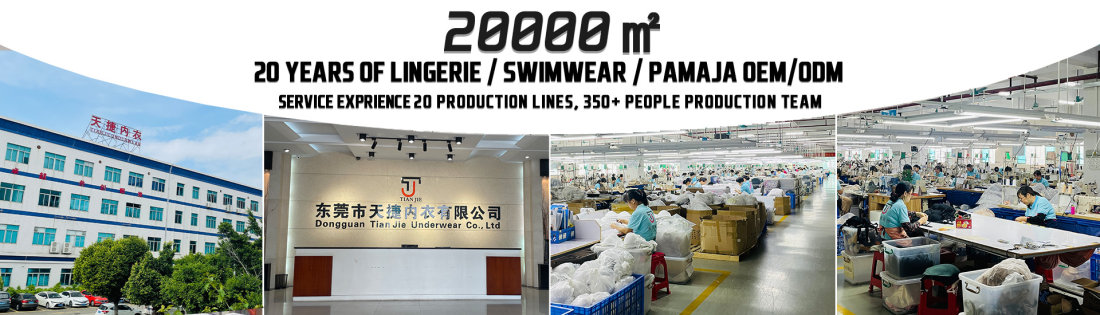
This article breaks down where the number comes from, why it differs between bras and pajamas, and the four ways buyers legitimately reduce it. It is written from the factory side: Tianjie Lingerie has been producing in Dongguan since 1998 and quotes MOQ per style per colour, not per order.
Where the MOQ number actually comes from
Four costs stack up before a single garment is sewn. The MOQ is the volume at which those four costs spread thin enough that the unit price becomes normal.
- Fabric minimum at the mill. A lace or knit mill will not run a custom dye lot for 300 metres. Their minimum is usually 500–1,000 metres, and a bra set consumes roughly 0.6–1.2 metres depending on the style. That alone lands you in the hundreds of pieces.
- Dye lot consistency. If your order is split across two dye lots, the two halves will not match under daylight. Factories avoid this by producing one lot, which means one minimum quantity.
- Cutting setup. Spreading, marking and cutting a lay has a fixed cost in labour and machine time regardless of whether the lay is 40 plies or 200 plies.
- Sewing line changeover. A line retooled for a new style runs slower for the first day or two. On a 300-piece order, that ramp-up is most of the order.
- Trims and hardware. Hooks, sliders, rings, boning and elastic all have their own minimums, and they are usually sold by the thousand.
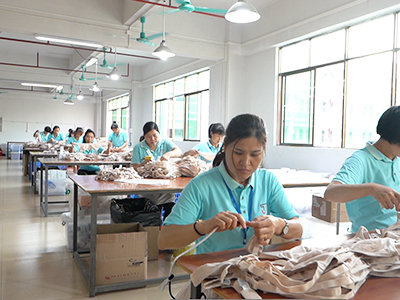
Why a bra set and a pajama set do not share a MOQ
The MOQ follows the fabric, not the product category. A satin pajama set uses a wide, continuous fabric with few components, so the mill minimum converts into fewer pieces. A padded bra uses several narrow fabrics, moulded cups, wire casing, and up to fifteen trims — all with separate minimums that have to line up.
| Product | Typical MOQ per style per colour | What pushes it up |
|---|---|---|
| Basic soft-cup bra set | 1,000 – 1,500 pcs | Custom lace, custom dye |
| Padded / moulded bra set | 1,500 – 3,000 pcs | Cup moulds, multiple trims |
| Corset | 1,000 – 2,000 pcs | Boning, busk hardware |
| Satin pajama set | 1,000 – 2,000 pcs | Printed or jacquard fabric |
| Swimwear bikini set | 1,000 – 2,000 pcs | Custom print, matching lining |
| Beachwear / cover-up | 800 – 1,500 pcs | Simple construction, few trims |
These are ranges for a first order. Repeat orders on the same style usually get a lower minimum, because the pattern, the trims and often the fabric are already in place.
Four legitimate ways to lower the MOQ
1. Use stock fabric instead of a custom dye lot
If the factory already holds the lace or the knit in a colour close to what you want, you skip the mill minimum entirely. The trade-off is a limited colour palette. Ask directly: which colours are in stock right now, and what is the MOQ on those? It is often half the custom-colour number.
2. Reduce the number of colours, not the number of pieces
MOQ is per colour. Three colourways at 1,000 each is a 3,000-piece order; one colourway at 1,500 is a 1,500-piece order and often gets a better unit price than three small runs. If you need colour variety for your shop, start with the best-selling colour and add the others on the repeat.
3. Accept a size assortment instead of a single size
Some factories will accept a smaller total quantity if you take a full size curve — for example 600 pieces spread across S–XL rather than 600 pieces in M. The cutting and sewing cost is the same, and the factory avoids being stuck with an unbalanced size stock.
4. Order a stock style with your label instead of a new development
If your first collection does not have to be entirely original, producing an existing style with your own label and your own packaging removes the pattern development and often the trim minimums. It is the standard way to start a private label brand without committing to 3,000 pieces per style.
The claim to be suspicious of
“No MOQ, we can do 50 pieces.” That is possible, but ask which of these is true: the fabric is stock, the style already exists, or there is a small-order surcharge. If the supplier cannot name one of the three, the 50-piece order will arrive with a different fabric than the sample.
How MOQ affects the unit price
Doubling the order quantity does not halve the price, because material is usually 40–60% of the cost and it scales linearly. What changes is the setup component. In practice, moving from 500 to 1,500 pieces typically reduces the unit price by 10–20%; moving from 1,500 to 5,000 reduces it by another 5–10%. Anyone quoting a 50% drop for a 3x quantity increase is either cutting the fabric quality or was overpriced at the low quantity.
What to send when you ask for an MOQ quote
An MOQ without a specification is meaningless, because the number depends on the fabric and the trims. To get an answer you can compare across suppliers, include:
- The style reference, or a photo with a description of the construction.
- Fabric preference — lace, mesh, satin, cotton, bonded — and whether it must be a custom colour.
- How many colourways you need for the first order.
- Your target retail price, so the supplier can tell you whether the construction is viable at that price.
- Whether you need your own label, hangtag and polybag.
Ask for an MOQ on a specific style
Send a reference sample or a photo and we will reply with the MOQ for that exact style, the sampling date and the fabric options that lower it.