Private Label Lingerie: How to Launch Your Own Brand
- Share
- Issue Time
- Oct 30,2026
Summary
What private label actually covers, the four things you need in place before the first order, how the cost structure works, and the mistakes that cost new lingerie brands the most money.

Private label means the factory produces an existing or adapted style and puts your label, your hangtag and your packaging on it. You are not designing a garment from zero — you are choosing a construction, specifying the fabric and colour, and owning the brand on the finished product.
That makes it the cheapest and fastest way to launch a lingerie brand: no pattern development, no mould tooling, and a first order that can start at the factory's standard MOQ rather than a custom development minimum.
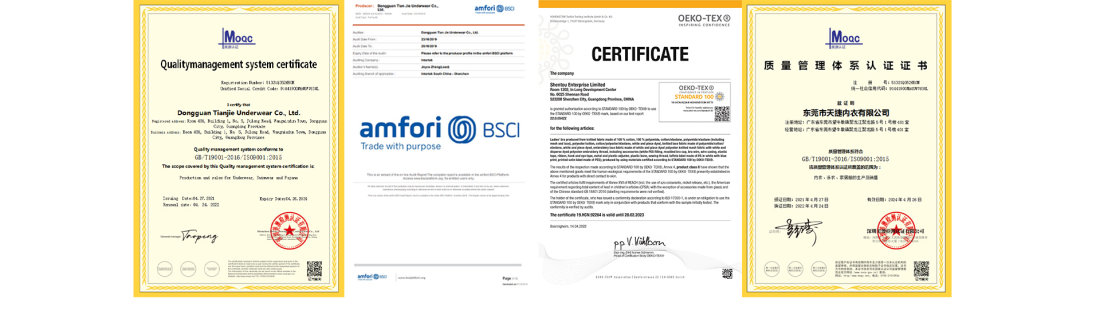
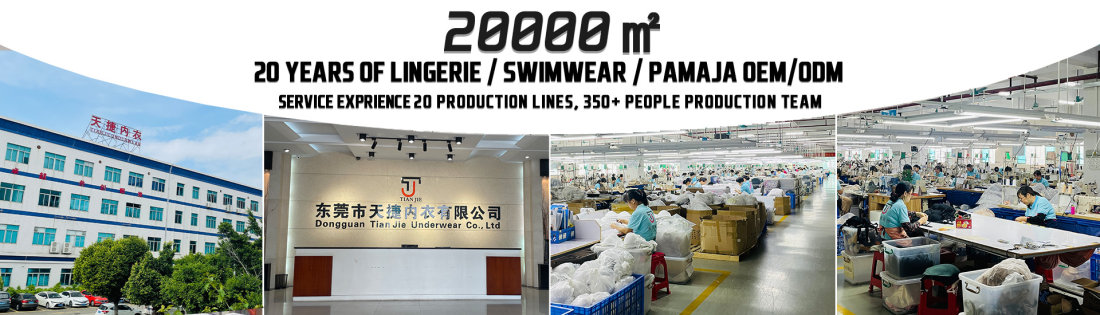
This guide covers what private label does and does not include, what you need in place before the first order, and where new brands lose money. It is written by Tianjie Lingerie, a factory in Dongguan producing for private labels since 1998.
What private label actually covers
Suppliers use the term loosely, so it is worth pinning down which of these are included in the price you were quoted.
| Item | Usually included | Usually charged separately |
|---|---|---|
| Woven main label, size label, care label | Yes | — |
| Printed hangtag | Sometimes | Yes, per 1,000 pcs |
| Polybag with your print | Sometimes | Yes |
| Printed tissue or box | No | Yes |
| Barcode sticker / EAN | No | You supply the numbers |
| Custom colour fabric | No | Yes, plus higher MOQ |
| Adapted pattern (your measurements) | No | Pattern fee |
| Photography for your shop | No | Sample cost only |
A private label quote that includes labels and polybags but not hangtags is normal. What is not normal is a supplier who cannot tell you which trims are included — that usually means the labels are being bought from a third party at a markup you are not seeing.

Four things to have ready before the first order
1. A brand name you can legally use in your market
Check the trademark in the country you will sell in before you print 5,000 labels. A factory will produce whatever name you send; it will not tell you that someone else registered it. Label changes on a repeat order usually carry a minimum of their own.
2. A size curve that matches your market
European and North American retail buyers expect different size ranges, and the labelling differs too: EU sizing, UK sizing, US sizing and the underlying measurements do not line up. Tell the factory which system you are labelling in, not just which sizes you want. Getting this wrong is the most common reason a first collection sells badly rather than not at all.
3. A decision on fabric: stock or custom
Stock fabric means a lower MOQ and a faster start, at the cost of a limited colour palette. Custom fabric means the colour you actually want, a mill minimum behind it, and several extra weeks. For a first collection, stock fabric in two or three colours is almost always the better trade.
4. Your packaging decision, made early
Polybag, printed bag, or box. This affects the carton dimensions, the shipping cost and the packing labour, and it has to be specified before the bulk order is quoted — not after. Changing packaging mid-production is one of the few things that reliably delays a shipment.
How the cost structure works
The unit price of a private label garment is the factory cost plus the branding cost, and the second part is smaller than most new brands expect.
- Garment cost — fabric, trims, labour, overhead. This is the bulk of the price and it is what scale reduces.
- Labels — woven main label, size and care labels. Typically a few cents per set at 1,000+ pieces.
- Hangtag — printing cost per 1,000, plus the attachment labour.
- Packaging — polybag is negligible; a printed box is not, and it also increases carton volume and therefore freight.
- Pattern fee — only if you adapt measurements. Usually a one-off, sometimes credited against the bulk order.
- Sample cost — per style, and frequently credited once the bulk order is placed.
For a first run, branding and packaging typically add a small percentage to the garment cost. Freight is where new brands get surprised: a printed box can add more to the landed cost than the box itself costs, because it takes up volume in the container.
A realistic timeline for a first collection
| Stage | Time | What you need to do |
|---|---|---|
| Style selection and quote | 3 – 7 days | Send references, target price, size system |
| Fabric and trim confirmation | 1 – 3 weeks | Approve physical swatches, not photos |
| Sampling | 2 – 3 weeks | Comment on fit and construction in writing |
| Sample revision | 1 – 2 weeks | Only if the fit needs changing |
| Label and packaging production | 2 – 3 weeks | Runs in parallel with sampling |
| Bulk production | 60 – 90 days | Approve the pre-production sample |
| Shipping | Varies by mode | Book freight before production ends |
Start to first delivery is realistically four to five months for a first collection with custom labels. Brands that plan for three months are the ones that air-freight the first order at four times the sea freight cost.
The mistake that costs the most
Approving a sample from a photo. Fabric hand feel, lace softness and elastic tension do not survive a phone screen. Ask for the physical sample, and if the timeline does not allow it, ask for a physical fabric swatch at minimum.
What to send us to start
To quote a private label order we need four things: the style or a reference photo, the fabric direction, the size system you will label in, and the quantity per colour. Everything else — labels, hangtags, packaging — can be settled while the sample is being made.
Start a private label order
Send your reference style and we will come back with the MOQ for that construction, the sampling date and what the labelling will add per piece.